

Most financial services firms in Australia don't struggle with compliance because they lack commitment. They struggle because the regulatory landscape keeps shifting beneath them, and the internal resources required to keep pace rarely match the scale of the obligation. Managing obligations across ASIC, APRA, and the Privacy Act simultaneously is a genuine operational challenge, not a governance checkbox.
That pressure is familiar to anyone responsible for keeping a financial services business on the right side of its regulatory obligations. The cost of maintaining compliance leadership is real, the complexity of multi-jurisdictional requirements is compounding, and the reputational consequences of getting it wrong are difficult to recover from.
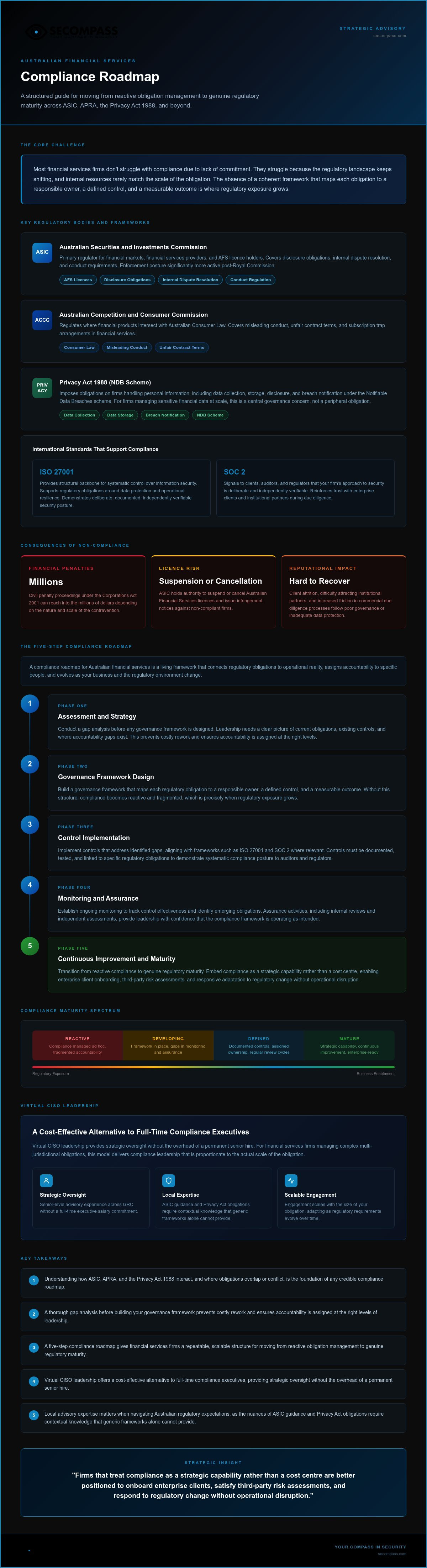
Building a sound compliance roadmap for Australian financial services doesn't require a complete overhaul of how your organisation operates. It requires a structured, strategic approach that aligns your existing capabilities with the regulatory expectations your business is accountable to. This guide walks through how to do exactly that, covering the key frameworks, leadership considerations, and practical steps that move a firm from reactive compliance to genuine maturity.
Key Takeaways
- A structured compliance roadmap for Australian financial services starts with understanding how ASIC, APRA, and the Privacy Act 1988 interact, and where your current obligations overlap or conflict.
- Conducting a thorough gap analysis before building your governance framework prevents costly rework and ensures accountability is assigned at the right levels of leadership.
- A five-step compliance roadmap gives financial services firms a repeatable, scalable structure for moving from reactive obligation management to genuine regulatory maturity.
- Virtual CISO leadership offers a cost-effective alternative to full-time compliance executives, providing strategic oversight without the overhead of a permanent senior hire.
- Local advisory expertise matters when navigating Australian regulatory expectations, as the nuances of ASIC guidance and Privacy Act obligations require contextual knowledge that generic frameworks alone cannot provide.
Understanding the Compliance Landscape for Australian Financial Services
Compliance in Australian financial services isn't a single obligation. It's a layered set of responsibilities that spans conduct regulation, data protection, consumer protection, and increasingly, cybersecurity governance. Understanding how those layers interact is the foundation of any credible compliance roadmap for Australian financial services firms.
The challenge most firms encounter isn't ignorance of the rules. It's the absence of a coherent framework that maps each obligation to a responsible owner, a defined control, and a measurable outcome. Without that structure, compliance becomes reactive and fragmented, which is precisely when regulatory exposure grows.
Key Regulatory Bodies in Australian Financial Services
Two bodies sit at the centre of conduct and consumer protection obligations for financial services firms operating in Australia.
ASIC (the Australian Securities and Investments Commission) holds primary responsibility for regulating financial markets, financial services providers, and the conduct of Australian Financial Services licence holders. Its guidance covers everything from disclosure obligations to internal dispute resolution requirements, and its enforcement posture has become considerably more active following the Royal Commission into Misconduct in the Banking, Superannuation and Financial Services Industry.
The ACCC (Australian Competition and Consumer Commission) plays a distinct but related role, particularly where financial products intersect with consumer law obligations under the Australian Consumer Law. Misleading conduct, unfair contract terms, and subscription trap arrangements in financial services all fall within its remit.
Beyond these two bodies, the Privacy Act 1988 imposes obligations on financial services firms that handle personal information, including requirements around data collection, storage, disclosure, and breach notification under the Notifiable Data Breaches scheme. For firms managing sensitive financial data at scale, Privacy Act compliance isn't peripheral. It's a central governance concern.
Aligning with International Standards
Regulatory compliance and security maturity aren't the same thing, though they increasingly reinforce each other. Frameworks like ISO 27001 and SOC 2 provide the structural backbone that helps financial services firms demonstrate systematic control over their information security environment, which in turn supports regulatory obligations around data protection and operational resilience. Aligning with these standards signals to clients, auditors, and regulators alike that your firm's approach to security is deliberate, documented, and independently verifiable.
Consequences of Non-Compliance
The penalties for non-compliance in Australian financial services are substantive. ASIC holds the authority to suspend or cancel Australian Financial Services licences, issue infringement notices, and pursue civil penalty proceedings. Financial penalties under the Corporations Act 2001 can reach into the millions of dollars depending on the nature and scale of the contravention.
Beyond the financial exposure, the reputational consequences are often harder to recover from. Client trust in financial services is hard-won and quickly lost. A firm that demonstrates poor governance or inadequate data protection practices doesn't just face regulatory scrutiny. It faces client attrition, difficulty attracting institutional partners, and increased friction in commercial due diligence processes.
The shift from merely meeting minimum regulatory requirements to fostering a genuine culture of compliance is where sustainable business growth begins. Firms that treat compliance as a strategic capability rather than a cost centre are better positioned to onboard enterprise clients, satisfy third-party risk assessments, and respond to regulatory change without operational disruption.
A Five-Step Compliance Roadmap for Financial Services
A compliance roadmap for Australian financial services isn't a document you file and revisit annually. It's a living framework that connects regulatory obligations to operational reality, assigns accountability to specific people, and evolves as your business and the regulatory environment change. The five steps below provide that structure.
Phase One: Assessment and Strategy
The roadmap begins with a gap analysis. Before any governance framework can be designed, leadership needs a clear picture of where current controls fall short against the obligations your firm actually carries. That means mapping your ASIC licence conditions, Privacy Act obligations, and any applicable APRA prudential standards against what your organisation currently has in place, not what's documented in policy, but what's operationally active.
This mapping exercise also surfaces regulatory overlaps. A data breach, for example, can simultaneously trigger Privacy Act notification requirements, ASIC disclosure obligations, and reputational risk to your AFS licence. Identifying those intersections early prevents fragmented responses later.
Cybersecurity controls sit within this same strategic layer. Aligning your security posture with the Essential Eight Implementation framework at this stage gives your compliance programme a measurable technical baseline that regulators and clients can both recognise. Once the gap analysis is complete, a governance framework can be built with confidence, defining risk appetite, assigning ownership across leadership, and establishing the escalation pathways that keep compliance visible at board level.
Phase Two: Operational Integration
Compliance that lives only in policy documents doesn't reduce risk. The third step in the roadmap is implementing operational controls that embed compliance into daily workflows without creating friction that drives workarounds. Data classification, access governance, and incident response procedures need to function as natural parts of how your teams operate, not as parallel obligations that slow productivity.
For firms handling sensitive client data at scale, a SOC 2 readiness assessment provides a structured lens for evaluating whether your security controls are genuinely fit for purpose. It identifies control gaps before they become audit findings and builds the documented evidence base that enterprise clients and institutional partners increasingly require during due diligence.
Steps four and five complete the cycle. Ongoing staff training ensures that compliance awareness doesn't erode between policy updates, and regular internal audits provide the feedback loop that separates firms with genuine compliance maturity from those simply maintaining appearances. Audits should produce actionable findings, not just confirmation of existing controls.
Firms that want to move through this roadmap with confidence, rather than rebuilding it each time a regulatory change arrives, benefit from having dedicated compliance leadership in place. If that's a gap in your current structure, speaking with a compliance advisory specialist is a practical starting point for understanding what that oversight model could look like for your organisation.
Leveraging Virtual CISO Leadership for Compliance Oversight
Executing a compliance roadmap for Australian financial services requires more than well-designed policies. It requires sustained strategic leadership, someone who can translate regulatory obligations into operational priorities, hold accountability at the executive level, and ensure the programme evolves as the environment changes. For most mid-market financial services firms, maintaining that capability through a full-time hire isn't commercially realistic. A Virtual CISO fills that gap with precision.
The vCISO model provides access to senior compliance and security leadership on a structured, ongoing basis. It's not a project engagement or a one-time audit. It's a continuous advisory relationship that sits alongside your leadership team, informing board-level decisions, guiding risk appetite conversations, and ensuring your governance framework keeps pace with regulatory change without requiring the overhead of a permanent executive appointment.
The Role of the vCISO in Financial Services
One of the persistent gaps in financial services compliance programmes is the disconnect between technical teams and executive leadership. Technical staff understand the controls. Leadership understands the business risk. A vCISO bridges that space, translating security and compliance findings into language that informs strategic decisions rather than generating reports that sit unread.
This bridge function becomes particularly valuable when a firm is working towards ISO 27001 certification. Certification isn't simply a technical exercise. It requires documented management commitment, clearly assigned ownership across the organisation, and a governance structure that auditors can verify. A vCISO provides the leadership continuity that makes certification achievable and sustainable beyond the initial audit cycle.
For firms operating in Melbourne and across the broader Australian market, working with a cyber security consultant in Melbourne who understands local regulatory expectations adds a layer of contextual knowledge that generic advisory engagements simply can't replicate. ASIC guidance, Privacy Act obligations, and APRA prudential standards all carry nuances that require genuine familiarity with how Australian regulators apply them in practice.
Building Trust Through Compliance Maturity
A mature compliance programme does something that reactive obligation management never can. It becomes a commercial asset. Institutional clients, enterprise partners, and sophisticated investors increasingly treat compliance maturity as a proxy for operational reliability. A firm that can demonstrate structured governance, documented controls, and proactive regulatory engagement is a firm that passes due diligence with confidence.
The competitive advantage here is tangible. Firms that anticipate regulatory change rather than scrambling to respond to it reduce operational disruption, protect client relationships, and position themselves as credible counterparties in high-value commercial arrangements. Security and privacy, approached consultatively rather than defensively, become differentiators rather than costs.
If your organisation is ready to move from obligation management to genuine compliance maturity, speaking with a SeComPass compliance advisory specialist is a practical first step toward understanding what structured vCISO leadership could look like for your business.
Moving From Obligation Management to Strategic Compliance Maturity
Building a credible compliance roadmap for Australian financial services is ultimately about creating a programme that holds its shape when regulatory expectations shift, not just one that satisfies the current audit cycle. The firms that achieve genuine maturity are those that assign clear accountability, embed controls into daily operations, and maintain strategic leadership continuity across the compliance function.
Three things matter most at this stage. A structured gap analysis gives leadership a reliable starting point. Operational integration ensures compliance lives in practice, not just in policy. And sustained advisory leadership, whether through a vCISO or a structured compliance partnership, keeps the programme aligned as your business and the regulatory environment evolve.
SeComPass works with Australian financial services firms to build exactly that kind of programme, combining local regulatory expertise with deep experience across ISO 27001, SOC 2, and virtual compliance management.
The path to compliance maturity is well-defined. With the right advisory partner alongside you, it's also far more achievable than most firms expect.
Frequently Asked Questions
What are the key components of a compliance roadmap for financial services in Australia?
A compliance roadmap for Australian financial services typically includes five core components: a regulatory gap analysis, a governance framework with clearly assigned ownership, operational control implementation, staff training, and a cycle of internal audits. Each component builds on the last, creating a programme that's structured rather than reactive.
The gap analysis is where most firms need to start. It maps your actual obligations under your AFS licence, the Privacy Act 1988, and any applicable APRA prudential standards against the controls you currently have operating in practice. That baseline determines everything else in the roadmap.
How do ASIC and ACCC guidelines impact my compliance strategy?
ASIC and the ACCC address different but overlapping concerns. ASIC focuses on conduct, disclosure, licensing obligations, and internal dispute resolution for AFS licence holders. The ACCC's influence becomes relevant where financial products intersect with consumer law, particularly around misleading representations, unfair contract terms, and subscription arrangements.
Your compliance strategy needs to account for both bodies because a single business decision, such as how a product is marketed or how a contract is structured, can attract scrutiny from either regulator. Mapping each obligation to a responsible owner within your governance framework is the most reliable way to ensure neither body's requirements fall through the gaps.
Is RMAI certification relevant for Australian financial services firms?
RMAI certification originates from the US receivables management industry and doesn't carry direct regulatory standing under Australian law. Australian financial services firms are accountable to ASIC, APRA, and the Privacy Act 1988, none of which reference RMAI as a recognised standard.
If your firm has cross-border operations or relationships with US-based partners, RMAI credentials may carry some commercial relevance in those specific contexts. For building a credible compliance programme domestically, frameworks like ISO 27001 and SOC 2 carry considerably more weight with Australian regulators, enterprise clients, and institutional partners.
How long does it typically take to implement a compliance roadmap?
Implementation timelines vary depending on the size of your organisation, the complexity of your regulatory obligations, and the maturity of your existing controls. A focused gap analysis and governance framework design can often be completed within six to twelve weeks. Full operational integration, including control embedding and staff training, generally takes longer.
Firms pursuing ISO 27001 certification alongside their compliance programme should plan for a more extended timeline, as certification requires documented evidence of controls operating consistently over time, not just a point-in-time assessment. Working with an advisory partner who can maintain leadership continuity across the programme reduces the risk of delays caused by internal resource constraints.
What role does a vCISO play in achieving compliance?
A vCISO provides the strategic leadership function that keeps a compliance programme coherent and accountable at the executive level. That means translating regulatory obligations into operational priorities, guiding risk appetite conversations with the board, and ensuring the governance framework evolves as your business and the regulatory environment change.
For mid-market financial services firms, this model offers a practical alternative to a full-time senior compliance hire. The vCISO sits alongside your leadership team on an ongoing basis, bridging the gap between technical teams and executive decision-makers. That continuity is particularly valuable when working towards certifications like ISO 27001, where demonstrated management commitment is a formal audit requirement.
How does the Australian Privacy Act influence data handling in financial services?
The Privacy Act 1988 imposes obligations on financial services firms that collect, store, use, or disclose personal information. This includes requirements around purpose limitation, data minimisation, secure storage, and breach notification under the Notifiable Data Breaches scheme. For firms managing client financial data at scale, these aren't peripheral requirements. They sit at the centre of your governance obligations.
A data breach in a financial services context can simultaneously trigger Privacy Act notification requirements and ASIC disclosure considerations, which is why Privacy Act compliance needs to be integrated into your broader governance framework rather than treated as a standalone obligation. A Privacy Impact Assessment is a practical tool for identifying data handling risks before they become regulatory exposure.

Article by
Jatinder Oberoi
Founder and Principal Consultant at SeComPass, a cybersecurity, privacy, governance, and compliance advisory firm supporting organisations across Australia and New Zealand. With extensive experience in cybersecurity leadership, risk management, ISO 27001, SOC 2, privacy, and governance advisory, he works closely with executive teams to help organisations strengthen operational resilience and improve cybersecurity maturity.
Known for his pragmatic and business focused approach, Jatinder specializes in translating complex cybersecurity and compliance challenges into clear, actionable strategies for leadership teams. His work focuses on helping organisations align security initiatives with business objectives, governance expectations, regulatory obligations, and long term resilience outcomes.
Through SeComPass, he regularly advises organisations on cybersecurity governance, AI risk, third party risk, compliance frameworks, security leadership, and enterprise resilience. His writing and advisory approach emphasizes clarity, practical decision making, and sustainable security maturity over fear driven cybersecurity messaging.


