
On 10 December 2026, the Australian privacy landscape reaches a critical milestone as new disclosure obligations for automated decision-making and the Children’s Online Privacy Code officially take effect. For many executive teams, these dates represent more than just a compliance deadline; they signal a permanent shift toward proactive accountability and systemic integrity. You likely recognise that managing these requirements demands a level of senior expertise that is increasingly difficult to source in a competitive talent market.
Engaging an outsourced data protection officer Australia provides a methodical way to bridge this gap, offering the strategic oversight needed to transform privacy from a potential liability into a core business strength. This guide demonstrates how an outsourced DPO delivers the regulatory maturity and board-level assurance required to navigate 2026’s complex governance expectations. We will outline a clear roadmap for achieving privacy maturity, ensuring your organisation remains resilient, compliant, and ready for the next phase of digital evolution.
Key Takeaways
- Understand how the DPO role has evolved into a critical governance pillar following Australia's significant privacy reforms.
- Discover how an outsourced data protection officer Australia provides access to a collective of senior specialists, ensuring higher operational resilience than a single in-house hire.
- Learn how to achieve executive-level privacy oversight while reducing the overhead and recruitment challenges associated with full-time internal roles.
- Identify strategies to transition from reactive compliance to a proactive privacy model that serves as a competitive differentiator for your organisation.
- Gain a clear roadmap for aligning your privacy strategy with international standards to provide board-level assurance and long-term stability.
Navigating Australia’s Privacy Reforms with Strategic Stewardship
The Australian Privacy Act reforms have fundamentally altered the corporate governance landscape. What was once seen as a back-office administrative task is now a central pillar of executive accountability. A Data Protection Officer (DPO) acts as a strategic steward, ensuring that privacy is not just a checkbox but a design principle integrated into every business process.
To better understand the core functions of this role, watch this helpful video:
By engaging an outsourced data protection officer australia, organisations gain access to senior-level advisory that aligns privacy strategy with broader business goals. This objective stewardship is particularly vital for meeting the Office of the Australian Information Commissioner's (OAIC) heightening expectations for leadership and accountability. When privacy is embedded into the design of new products and services from the outset, it ceases to be a hurdle and becomes a facilitator for innovation.
The 2026 Regulatory Landscape and Leadership Accountability
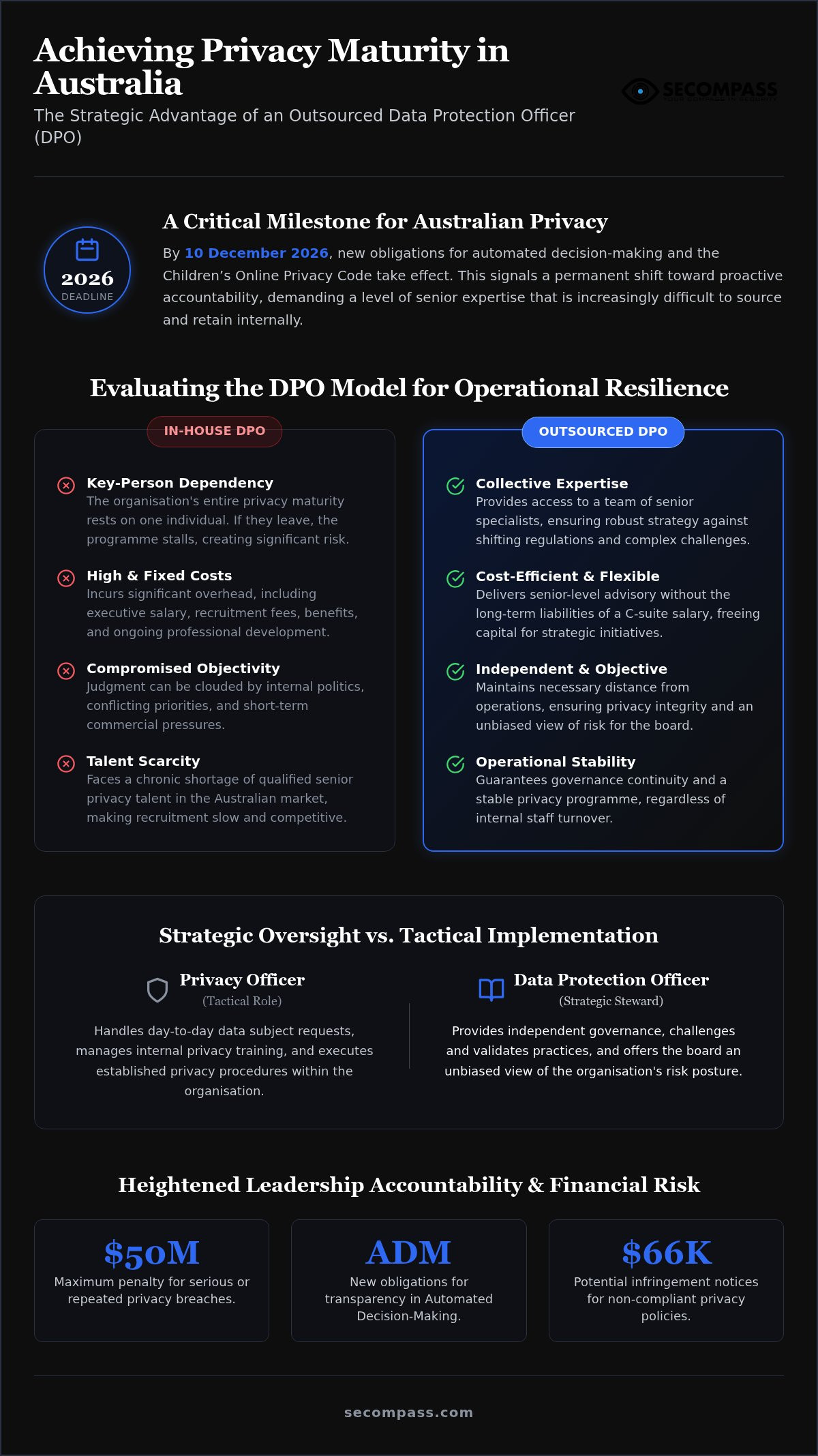
The risk profile for Australian executives shifted dramatically with the introduction of a $50 million penalty ceiling for serious or repeated breaches. Leadership can't delegate privacy to technical teams without senior oversight. By 10 December 2026, new obligations regarding automated decision-making (ADM) will require significantly higher levels of transparency in privacy policies. A DPO ensures these disclosures are accurate and that the underlying data handling is defensible, helping avoid the OAIC's $66,000 infringement notices for non-compliant policies.
The Distinction Between a Privacy Officer and a DPO
It's vital to differentiate between tactical implementation and strategic oversight. While a Privacy Officer might handle day-to-day data requests or internal training, a DPO provides the independent governance required to challenge and validate organisational practices. Selecting an outsourced DPO maintains this necessary distance from operational decision-making. This independence ensures that privacy integrity remains uncompromised by short-term commercial pressures, providing the board with an unbiased view of the organisation's risk posture.
Evaluating the Outsourced DPO Model for Operational Resilience
Choosing an outsourced data protection officer australia offers a level of operational resilience that a single internal hire rarely matches. While a full-time employee provides dedicated hours, an outsourced model provides access to a collective of senior specialists. This depth of expertise ensures that your privacy strategy remains robust even as regulatory requirements shift or complex technical challenges arise.
Cost efficiency is a primary driver for this shift. By removing the significant executive overhead, recruitment fees, and ongoing professional development costs associated with a high-level in-house hire, organisations can redirect capital toward other strategic initiatives. You gain access to senior-level advisory without the long-term liabilities of a C-suite salary.
Assessing In-house Capacity versus Objective Advisory
The Australian market currently faces a chronic shortage of qualified privacy talent. This scarcity often leads to key-person dependency, where an organisation’s entire privacy maturity rests on the shoulders of one individual. If that person leaves, the programme often stalls. Engaging an outsourced data protection officer australia ensures that your governance remains stable regardless of internal staff turnover.
An outsourced model also provides an objective perspective, free from the internal politics or conflicting priorities that can sometimes cloud the judgement of staff members. This independence is essential for maintaining the integrity of your privacy programme. If you’re looking to stabilise your governance structure, you might consider scheduling a security assessment to identify your current gaps.
Integrating DPO Services into Existing Frameworks
Privacy doesn’t exist in a vacuum. It must be woven into your existing governance structures to be effective. A mature DPO service aligns privacy advisory with international standards like ISO 27001, ensuring that data protection is treated as a core component of information security rather than an isolated legal obligation.
As we approach late 2026, this integration becomes even more critical for supporting AI governance frameworks. A strategic DPO helps your leadership team navigate the ethical and privacy implications of emerging technologies, ensuring that data handling remains defensible and aligned with both regulatory requirements and community expectations.
Implementing Privacy as a Strategic Business Enabler
A mature privacy programme functions as more than a compliance shield; it serves as a strategic differentiator. In a market where consumer trust is fragile, demonstrating a commitment to data integrity builds significant rapport with customers, partners, and investors. By moving beyond a "tick-box" approach, your organisation can transform privacy from a regulatory burden into a core business asset that supports long-term growth and operational resilience.
The transition from reactive compliance to proactive risk management requires steady, senior-level leadership. Engaging an outsourced data protection officer australia allows your executive team to focus on innovation and market expansion while maintaining a robust security posture. This partnership ensures that privacy considerations are integrated into the business strategy from the outset, rather than being retrofitted during a crisis. It's about enabling the business to move faster, with the confidence that the guardrails are already in place.
Effective governance also demands transparency at the highest levels. Your virtual DPO facilitates this by providing regular, structured reporting to the Board. These briefings ensure that directors have the clarity needed to make informed decisions regarding privacy risks and maturity investments, fulfilling their oversight obligations without getting bogged down in technical minutiae.
Building a Roadmap for Privacy Maturity and Board Assurance
The journey toward systemic integrity begins with a comprehensive gap analysis. This process identifies immediate regulatory risks and provides the data needed to prioritise high-impact governance improvements. From there, your advisor helps develop a multi-year maturity roadmap. This document provides a clear path forward, outlining how the organisation will evolve its practices to meet both current obligations and future expectations. It isn't just about fixing what's broken; it's about building a sustainable framework for the future.
Managing Third-Party Risks and Data Breach Response
Your privacy posture is only as strong as your weakest vendor. A DPO plays a critical role in evaluating the privacy practices of supply chain partners, ensuring that third-party risks don't become your own liabilities. Additionally, they ensure a robust Notifiable Data Breaches (NDB) scheme response plan is in place. This plan must be regularly tested and refined through tabletop exercises, ensuring your team is prepared to act with precision and composure if an incident occurs.
Securing Your Organisation’s Future through Strategic Privacy Leadership
The 2026 regulatory environment in Australia demands a transition from reactive data handling to a model of systemic integrity and board-level accountability. The path to privacy maturity involves more than meeting immediate deadlines. It requires a long-term commitment to governance that protects your reputation and enables sustainable innovation.
By partnering with an outsourced data protection officer australia, your leadership team gains access to the specialised vDPO and vCISO expertise necessary to navigate these changes with confidence. Our Melbourne-based strategic advisory team provides the objective oversight needed to bridge the current talent gap while ensuring your privacy programme remains both cost-effective and operationally resilient. This collaborative approach allows you to focus on your core business objectives, knowing that your regulatory obligations are managed by experienced mentors.
Establishing a robust privacy framework today ensures your organisation is prepared for the complexities of tomorrow. We look forward to supporting your progress toward a more resilient and trustworthy digital future.
Frequently Asked Questions
Is an outsourced Data Protection Officer legally required for Australian businesses?
No, a DPO is not currently a strict legal requirement for all Australian businesses under the Privacy Act 1988. However, appointing one is considered a primary way to meet Australian Privacy Principle 1.2, which requires entities to implement practices and systems that ensure compliance. As of 1 July 2026, expanded coverage for small businesses in sectors like real estate and legal makes designated privacy leadership even more critical for managing increased regulatory scrutiny and the potential for significant penalties.
How does an outsourced DPO ensure their independence within our organisation?
An outsourced data protection officer australia ensures independence by maintaining a clear separation from your organisation’s day-to-day operational decision-making. Because the advisor is an external partner, they aren't subject to the same internal performance pressures or departmental biases as a full-time employee. This allows them to provide unbiased reporting directly to the Board or CEO, ensuring that privacy risks are identified and managed with the necessary objectivity to maintain systemic integrity.
Can a vDPO assist with achieving ISO 27001 or SOC 2 certifications?
Yes, a vDPO is instrumental in aligning your privacy programme with international standards such as ISO 27001 and SOC 2. These frameworks increasingly require integrated privacy controls, particularly when handling sensitive personal information across global borders. By synchronising your privacy maturity with these certifications, the DPO ensures that your organisation meets international expectations for data protection. This alignment is essential for building trust with partners and securing enterprise-level contracts.
What is the typical engagement model for an outsourced DPO service?
The typical engagement model for an outsourced data protection officer australia is a flexible, retainer-based service tailored to your organisation’s specific risk profile and maturity level. This often begins with a comprehensive gap analysis to establish a baseline of compliance. Once the roadmap is defined, the advisor provides ongoing strategic stewardship, regular Board reporting, and guidance on privacy impact assessments. This model allows you to scale the level of advisory support as your business evolves.

Article by
Jatinder Oberoi
Founder and Principal Consultant at SeComPass, a cybersecurity, privacy, governance, and compliance advisory firm supporting organisations across Australia and New Zealand. With extensive experience in cybersecurity leadership, risk management, ISO 27001, SOC 2, privacy, and governance advisory, he works closely with executive teams to help organisations strengthen operational resilience and improve cybersecurity maturity.
Known for his pragmatic and business focused approach, Jatinder specializes in translating complex cybersecurity and compliance challenges into clear, actionable strategies for leadership teams. His work focuses on helping organisations align security initiatives with business objectives, governance expectations, regulatory obligations, and long term resilience outcomes.
Through SeComPass, he regularly advises organisations on cybersecurity governance, AI risk, third party risk, compliance frameworks, security leadership, and enterprise resilience. His writing and advisory approach emphasizes clarity, practical decision making, and sustainable security maturity over fear driven cybersecurity messaging.


