
For many Australian business leaders, the realisation that all ISO 27001:2013 certificates expire on 31 October 2025 arrives right as a key enterprise client requests proof of compliance with the updated 2022 standard. It is a high-stakes moment where the pressure to secure a JAS-ANZ accredited certification often clashes with the reality of limited internal resources and the perceived complexity of the new control sets. You likely recognise that while certification is a prerequisite for growth, the path to achieving it often feels like a significant disruption to your core business activities.
We understand that a predictable ISO 27001 timeline is essential for strategic planning and executive confidence. This article provides a structured breakdown of the six to twelve month journey toward certification, offering a clear roadmap that balances rigorous governance with operational efficiency. We will explore the critical milestones of the readiness assessment, the implementation of the Information Security Management System, and the final stages of the external audit process. By the end of this briefing, you will have a realistic expectation of the resources required to achieve a successful outcome without compromising your organisation's primary focus.
Key Takeaways
- Understand why a realistic ISO 27001 timeline usually spans six to twelve months and how to align this journey with your broader business objectives.
- Learn how the pre-audit phase establishes a governance foundation through a comprehensive gap analysis, typically requiring four to six months of focused preparation.
- Discover the importance of selecting a JAS-ANZ accredited certification body to ensure your Stage 1 and Stage 2 audits carry international weight and credibility.
- Recognise that maintaining compliance is a continuous process within a three-year cycle, shifting the focus from initial implementation to long-term operational resilience.
- Identify strategies to achieve certification with minimal disruption to your daily operations, satisfying the security requirements of your most demanding enterprise partners.
The Pre-Audit Phase: Laying the Governance Foundation
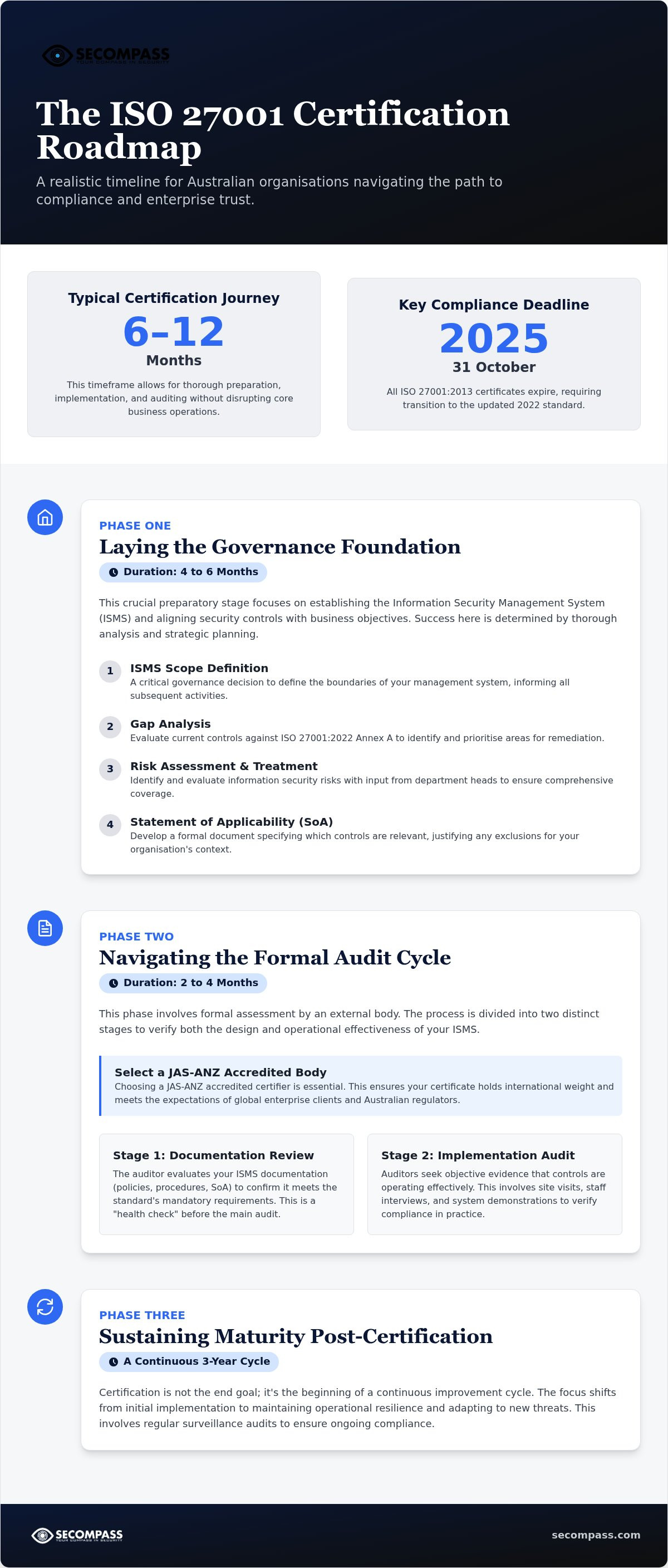
The journey toward certification begins well before an auditor steps through the door. For most Australian organisations, the pre-audit phase typically spans four to six months. This duration depends heavily on your current security maturity and the complexity of your operations. At the heart of this process is the Information Security Management System (ISMS), which is the central framework for managing sensitive corporate information through risk management. Establishing the ISMS scope is a critical governance decision that defines the boundaries of your protection and informs the entire ISO 27001 timeline.
To better understand the structure of the ISO/IEC 27001 standard and how it supports your business, watch this helpful overview:
The Critical Role of the Gap Analysis
A comprehensive gap analysis serves as the baseline for your project. It involves evaluating current controls against the ISO 27001:2022 Annex A requirements to identify immediate priorities. Remediation efforts often involve updating internal policies, improving physical security, or reorganising access controls to meet the standard's expectations. Engaging a virtual CISO during this stage ensures strategic alignment with your business goals, preventing the "compliance for compliance's sake" trap.
Risk Assessment and the Statement of Applicability
The risk assessment process requires active input from department heads to ensure all business threats are identified. It isn't just a technical exercise; it's a leadership responsibility. Once risks are mapped, you'll develop the Statement of Applicability (SoA). This document specifies which ISO controls are relevant to your specific Australian operations. Finalising the SoA is a major milestone. It signals your readiness for the formal audit cycle and provides a clear map for the months ahead.
The Formal Audit Cycle: Navigating Stage 1 and Stage 2
Once your governance foundation is established, the formal external audit process begins. This phase usually requires two to four months to complete, a duration often dictated by the availability of qualified auditors in the Australian market. Selecting a JAS-ANZ accredited certification body is essential for this process. This specific accreditation ensures your certificate carries the international recognition required by global enterprise clients and aligns with local regulatory expectations, such as the Australian Privacy Act. It's a strategic choice that validates the maturity of your security posture to external stakeholders.
Before the external auditor arrives, your organisation must conduct a thorough internal audit. This is a mandatory step to verify the effectiveness of your ISMS and identify any lingering gaps. A common misconception regarding the ISO 27001 timeline is that Stage 1 and Stage 2 audits can be performed in the same week. In practice, certification bodies require a cooling-off period between these stages. This gap allows your team to remediate any findings from the initial review, ensuring the second stage proceeds smoothly without avoidable setbacks.
Stage 1: The Documentation Review
The Stage 1 audit is primarily a review of your management system's design. The auditor evaluates your documentation to ensure it meets the mandatory requirements of the official ISO 27001 standard. This stage identifies high-level non-conformities that could prevent certification if left unaddressed. It serves as a valuable "health check" for your preparation efforts. To ensure your leadership team is comfortable with the auditor's line of questioning, you may find it helpful to review our strategic ISO 27001 audit tips.
Stage 2: The Implementation Audit
The Stage 2 audit shifts the focus from documentation to evidence. Auditors look for objective proof that your policies are followed in daily operations. This involves site visits, staff interviews, and technical demonstrations of security controls. If you've maintained a steady rhythm of compliance, this stage is a confirmation of existing habits rather than a frantic scramble for evidence. Successful completion leads to a recommendation for certification, which is typically issued within several weeks of the final closing meeting. If you are ready to move beyond the planning phase, you can schedule a security assessment to confirm your audit readiness.
Sustaining Maturity: Post-Certification and Surveillance
Achieving the certificate is a significant milestone, but it marks the transition from implementation to stewardship. ISO 27001 certification operates on a three-year cycle, requiring annual surveillance audits to ensure the system remains robust. Throughout this period, the focus shifts toward continuous improvement and active monitoring of the ISMS. It is also a requirement to report any significant changes in your security posture, such as major mergers or infrastructure shifts, to your certification body. Understanding this long-term commitment is vital for budgeting, as the ongoing maintenance directly influences the total cost of ISO 27001 certification for your organisation.
Annual Surveillance Audits
Surveillance audits take place in years one and two. These assessments are smaller in scope than the initial audit, yet they require consistent evidence that your security controls are performing as intended. Rather than a total system review, the auditor focuses on specific areas and the overall health of the management system. To reduce the administrative burden on your internal teams, many Australian enterprises adopt a virtual compliance management approach. This ensures that evidence collection remains a business-as-usual activity rather than a panicked annual event.
The Recertification Milestone
In the third year, the ISO 27001 timeline reaches a full recertification audit. This is a comprehensive review designed to renew your certificate for another three-year cycle. It provides a strategic opportunity to refine the ISMS based on operational data and incident history. For a deeper look at the technical nuances of this stage, the APNIC comprehensive guide to ISO 27001 certification offers excellent context for Asia-Pacific leaders. Strategic leadership ensures the ISMS evolves alongside the business, supporting long-term growth and maintaining the trust of your partners.
If you are ready to ensure your security framework remains a strategic asset, speak with our experts to discuss your cybersecurity maturity journey.
Securing Your Strategic Path to Compliance
Managing the transition to the 2022 standard is a significant undertaking that transforms how your organisation manages risk and builds trust with enterprise partners. Success relies on viewing the process as a strategic evolution rather than a technical hurdle. By establishing a strong governance foundation and preparing thoroughly for the formal audit cycle, you ensure that your security posture remains a competitive advantage.
Managing your ISO 27001 timeline effectively requires more than just following a schedule; it demands senior-level oversight and a commitment to long-term maturity. With offices in Melbourne and Auckland, SeComPass provides the local expertise and strategic advisory needed to guide you through JAS-ANZ accredited certification pathways. Our approach focuses on delivering practical business outcomes that enhance operational resilience while minimising disruption to your daily activities.
We look forward to supporting your leadership team as you build a foundation of enterprise-grade trust and strategic clarity.
Frequently Asked Questions
How long does the ISO 27001 certification process take for a mid-sized Australian business?
For a mid-sized Australian enterprise, the typical ISO 27001 timeline spans between six and twelve months from the initial gap analysis to the final certification decision. This duration accounts for the time required to develop policies, implement technical controls, and gather sufficient operational evidence to satisfy an external auditor. Organisations with high existing security maturity may achieve this sooner, while those with complex multi-site operations should plan for the longer end of this range.
Can we fast-track the ISO 27001 timeline if we have an urgent contract requirement?
Internal preparation can be accelerated with dedicated resources, but the external audit schedule is often constrained by the availability of JAS-ANZ accredited certification bodies. If you face an urgent contract requirement, we recommend completing a formal readiness assessment or a gap analysis report. This provides a credible document you can share with enterprise clients to demonstrate your commitment and progress while the formal certification cycle remains underway.
What is the difference between Stage 1 and Stage 2 audits in the timeline?
Stage 1 is a documentation review where the auditor ensures your management system design meets the standard's mandatory requirements. Stage 2 is the implementation audit, where the focus shifts to verifying that your team actually follows those documented processes in daily operations. These stages are separated by a mandatory cooling-off period, which allows your organisation to address any high-level findings identified during the initial review before the final assessment.
How much time should we allocate for the internal audit before the external certifier arrives?
You should generally allocate four to six weeks for the internal audit process, including the time needed for reporting and remediation. While the audit itself may only take a few days of active interviewing, the subsequent correction of any identified gaps is essential for a successful external outcome. Completing this milestone thoroughly ensures there are no surprises when the formal certifier arrives to evaluate your system's effectiveness.

Article by
Jatinder Oberoi
Founder and Principal Consultant at SeComPass, a cybersecurity, privacy, governance, and compliance advisory firm supporting organisations across Australia and New Zealand. With extensive experience in cybersecurity leadership, risk management, ISO 27001, SOC 2, privacy, and governance advisory, he works closely with executive teams to help organisations strengthen operational resilience and improve cybersecurity maturity.
Known for his pragmatic and business focused approach, Jatinder specializes in translating complex cybersecurity and compliance challenges into clear, actionable strategies for leadership teams. His work focuses on helping organisations align security initiatives with business objectives, governance expectations, regulatory obligations, and long term resilience outcomes.
Through SeComPass, he regularly advises organisations on cybersecurity governance, AI risk, third party risk, compliance frameworks, security leadership, and enterprise resilience. His writing and advisory approach emphasizes clarity, practical decision making, and sustainable security maturity over fear driven cybersecurity messaging.


