

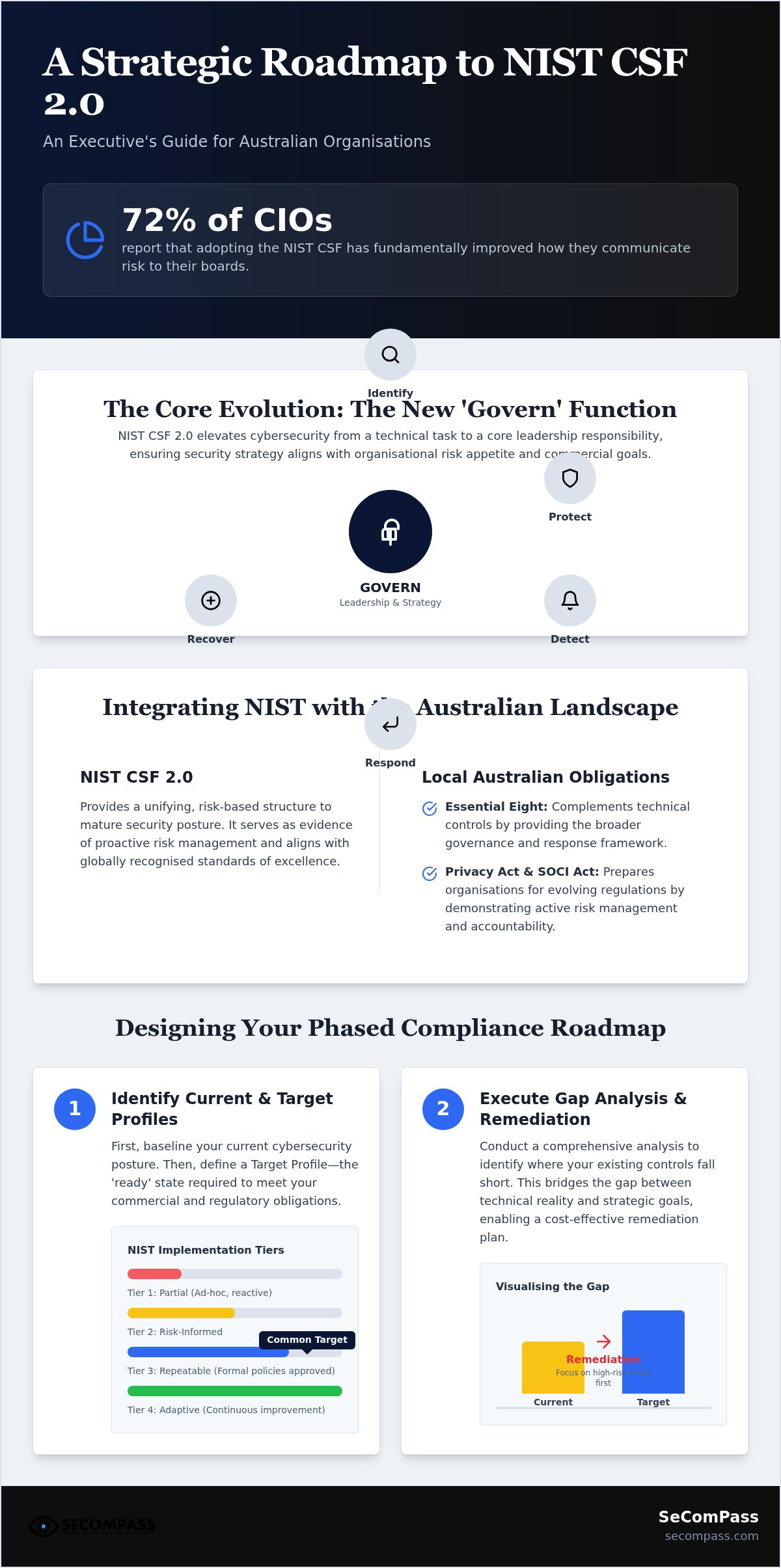
While technical teams often focus on the mechanics of defence, 72% of CIOs now report that adopting the NIST CSF 2.0 framework has fundamentally improved how they communicate risk to their boards. For many Australian executives, the challenge lies in translating a comprehensive international framework into a local context that respects the Essential Eight and existing regulatory obligations. It is common to feel overwhelmed by the perceived complexity of this transition, particularly when internal expertise is stretched thin across competing business priorities.
We recognise that a successful NIST compliance roadmap is not merely a security project, it is a strategic governance evolution led by the framework's new focus on leadership accountability. This guide provides a structured, phased approach to help you navigate the journey to CSF 2.0, ensuring your cyber resilience aligns with your broader commercial objectives. We will outline how to bridge the gap between technical controls and executive oversight, providing you with the clarity needed to lead your organisation toward long-term maturity and regulatory confidence.
Key Takeaways
- Understand how the new "Govern" function in NIST CSF 2.0 elevates cybersecurity from a technical concern to a core board-level responsibility.
- Discover how to design a phased NIST compliance roadmap that prioritises organisational profiles and target tiers for sustainable maturity.
- Learn to bridge the gap between international frameworks and local Australian requirements, including the Essential Eight and SOCI Act obligations.
- Identify the strategic benefits of integrating Virtual CISO (vCISO) oversight to maintain compliance and drive continuous security improvement.
- Gain confidence in reporting security maturity to the board by aligning technical controls with clear business resilience goals.
Navigating the NIST CSF 2.0 Framework in the Australian Regulatory Landscape
The NIST Cybersecurity Framework (CSF) 2.0 is often misunderstood as a rigid checklist or a binary certification. In reality, it functions as a flexible, risk-based instrument designed to help organisations manage and reduce cybersecurity risk in a way that aligns with their unique business objectives. For Australian enterprises, this flexibility is vital. It allows leadership to move away from reactive, fragmented security spending and instead invest in a cohesive NIST compliance roadmap that matures over time.
A structured approach is necessary because security maturity isn't achieved through isolated technical fixes. Without a strategic roadmap, organisations often find themselves in a cycle of "whack-a-mole" security, where budgets are consumed by the crisis of the day rather than long-term resilience. NIST provides the common language required to break this cycle, facilitating clearer communication between technical teams and the executive suite.
The Strategic Importance of the Govern Function
The most significant evolution in version 2.0 is the addition of the "Govern" function. While previous iterations focused heavily on technical execution, Govern places the responsibility for cybersecurity strategy firmly within the remit of senior leadership and the board. Governance provides the necessary direction for the other five functions: Identify, Protect, Detect, Respond, and Recover. It ensures that security policies are not just technical documents, but are informed by the organisation's specific risk appetite and commercial goals. This top-down approach transforms cybersecurity from a cost centre into a pillar of operational resilience.
Mapping NIST to Australian Compliance Obligations
Australian organisations often face a crowded regulatory environment. NIST CSF 2.0 doesn't replace local standards; rather, it provides a unifying structure that enhances them. For example, many firms already focus on Essential Eight implementation to address immediate technical threats. NIST complements these controls by providing the broader governance and response frameworks that the Essential Eight may not fully cover.
Aligning with NIST also prepares organisations for the ongoing evolution of the Australian Privacy Act. As regulatory expectations shift toward demonstrating active risk management and accountability, a well-structured NIST compliance roadmap serves as evidence of a mature, proactive security posture. This alignment ensures that as local laws become more stringent, your organisation is already operating at a globally recognised standard of excellence.
Designing a Phased NIST Compliance Roadmap for Sustainable Maturity
Building a NIST compliance roadmap requires a shift from viewing security as a series of isolated technical tasks to treating it as a structured business process. This phased approach ensures that resources are allocated where they provide the greatest risk reduction, preventing the common mistake of over-investing in low-impact tools. By following a methodical path, leadership can demonstrate clear progress to stakeholders while building a culture of continuous improvement.
Step 1: Identifying the Current and Target Profiles
The first stage involves developing an Organisational Profile. This baseline describes your current cybersecurity posture in plain business terms. You then define a Target Profile, which outlines the "ready" state required to meet your specific commercial goals and regulatory obligations. To support this, NIST defines four Implementation Tiers, ranging from Partial (Tier 1) to Adaptive (Tier 4). Most mid-market Australian firms aim for Tier 3 (Repeatable), which indicates that risk management practices are formally approved and expressed as policy. Consulting the official NIST Cybersecurity Framework resources can help your leadership team select the tier that best balances security needs with operational costs.
Step 2: Executing the Gap Analysis and Remediation Plan
Once your profiles are established, you must conduct a comprehensive gap analysis against the CSF 2.0 Core. This process identifies exactly where your existing controls fall short of your target state. A gap analysis acts as the essential bridge between technical reality and strategic goals. By highlighting these discrepancies, you can create a cost-effective remediation plan that targets high-risk areas first. This ensures that your NIST compliance roadmap remains focused on business impact rather than just technical volume.
Remediation should always be prioritised based on the potential impact on your core services and third-party risks. Once controls are implemented, documenting evidence becomes the final, critical step. This documentation provides the necessary assurance to the board and external partners that your security maturity is both verified and sustainable. If you are ready to begin this process, you might choose to schedule a security assessment to define your current baseline.
Sustaining Compliance through Strategic Leadership and vCISO Oversight
Achieving initial alignment with the NIST framework is a significant milestone, yet the true value of a NIST compliance roadmap lies in its long-term operationalisation. Cybersecurity is not a static destination or a one-off audit; it is a continuous journey of maturity that must adapt as threats and business environments evolve. Sustaining this momentum requires dedicated leadership to ensure that the controls implemented during the remediation phase don't degrade over time.
Leadership accountability is particularly critical when managing third-party and supply chain risks, which are now central to the CSF 2.0 "Govern" function. By maintaining a live roadmap, organisations can provide the board with regular, evidence-based reports on security maturity. This level of transparency transforms cybersecurity from a technical "black box" into a manageable business risk, fostering a culture of ongoing accountability at the highest levels of the organisation.
The vCISO as a Strategic Enablement Partner
For many Australian organisations, the challenge isn't a lack of intent, but a lack of internal capacity to lead a multi-year maturity programme. Engaging a Virtual CISO (vCISO) provides the strategic oversight needed to maintain the NIST compliance roadmap without the overhead of a full-time executive. This model allows for high-level advisory that scales with the organisation's needs, providing a stabilizing force through periods of growth or regulatory change.
Partnering with a cyber security consultant in Melbourne or Auckland ensures your leadership team stays informed about local regulatory shifts and enterprise expectations. This "Wise Guide" approach ensures that security remains an enabler of business progress rather than a bureaucratic hurdle, allowing your internal teams to focus on core operations.
Integrating NIST into the Broader Assurance Strategy
A mature NIST posture provides a robust foundation for other international standards. For example, the overlap between NIST controls and ISO requirements can significantly reduce the cost of ISO 27001 certification by streamlining the implementation of shared controls. This "comply once, report many" philosophy is essential for reducing audit fatigue and operational friction across the enterprise.
By building your assurance strategy around a unified framework, you create a scalable system of systemic integrity. This ensures that whether you are reporting to a local regulator, an international partner, or your own board, your security narrative remains consistent, professional, and grounded in strategic clarity. Long-term resilience is built on these foundations of order and meticulous oversight.
Securing Your Organisation’s Strategic Future
Adopting the NIST CSF 2.0 framework represents a pivotal shift from managing technical vulnerabilities to overseeing enterprise risk. By developing a structured NIST compliance roadmap, your leadership team can bridge the gap between complex security requirements and the practical need for business enablement. This approach ensures that your investments in security are deliberate, measurable, and fully aligned with Australian governance expectations.
With offices in Melbourne and Auckland, our team provides the specialised vCISO leadership required to navigate this multi-year maturity journey. We help you integrate international standards with local priorities, such as the Essential Eight, ensuring your organisation remains resilient in a shifting regulatory environment. This steady focus on governance allows you to report security maturity to the board with absolute confidence.
We are committed to helping you achieve a state of lasting assurance and systemic integrity. Together, we can transform compliance from a regulatory burden into a strategic advantage for your business.
Frequently Asked Questions
Is NIST compliance mandatory for private companies in Australia?
NIST CSF 2.0 is primarily a voluntary framework in Australia, though it is increasingly viewed as a de facto standard for demonstrating director-level due diligence. However, for entities responsible for high-risk assets under the Security of Critical Infrastructure (SOCI) Act, alignment with a recognised framework like NIST is a regulatory requirement. Even where not legally mandated, many enterprise clients now require NIST alignment as a condition of their third-party risk management processes.
How does NIST CSF 2.0 differ from the previous version for business leaders?
The most significant change for leadership is the addition of the "Govern" function, which elevates cybersecurity from a technical task to a strategic board-level responsibility. Unlike previous versions that focused primarily on critical infrastructure, CSF 2.0 is designed for organisations of all sizes and sectors. This update emphasises that effective security starts with leadership defining risk appetite and organisational policy rather than just deploying technical controls.
Can NIST alignment help our organisation achieve ISO 27001 or SOC 2 faster?
Yes, executing a NIST compliance roadmap creates a strong foundation that accelerates other certifications like ISO 27001 or SOC 2. Because these frameworks share a high density of common controls, the evidence gathered for NIST can often be repurposed for other audits. This approach reduces the operational burden on your team and ensures a consistent security narrative across different regulatory requirements, effectively allowing you to comply once and report many times.
What is the typical timeframe for completing a NIST compliance roadmap?
The timeline for a NIST compliance roadmap typically spans 12 to 24 months, depending on your organisation's current maturity level and available resources. Initial assessments and profile establishment usually take three to six months, followed by a phased remediation period to address identified gaps. It is important to view this as a continuous cycle of improvement rather than a project with a fixed end date, as maintaining maturity requires ongoing leadership oversight and regular reporting.

Article by
Jatinder Oberoi
Founder and Principal Consultant at SeComPass, a cybersecurity, privacy, governance, and compliance advisory firm supporting organisations across Australia and New Zealand. With extensive experience in cybersecurity leadership, risk management, ISO 27001, SOC 2, privacy, and governance advisory, he works closely with executive teams to help organisations strengthen operational resilience and improve cybersecurity maturity.
Known for his pragmatic and business focused approach, Jatinder specializes in translating complex cybersecurity and compliance challenges into clear, actionable strategies for leadership teams. His work focuses on helping organisations align security initiatives with business objectives, governance expectations, regulatory obligations, and long term resilience outcomes.
Through SeComPass, he regularly advises organisations on cybersecurity governance, AI risk, third party risk, compliance frameworks, security leadership, and enterprise resilience. His writing and advisory approach emphasizes clarity, practical decision making, and sustainable security maturity over fear driven cybersecurity messaging.


