
If your board still views the Essential Eight as a static technical checklist, they are likely unprepared for the Australian Signals Directorate’s transition to the new Essentials series announced in June 2026. While the core mitigation strategies remain the gold standard for blocking up to 95% of malware execution, the governance landscape has shifted significantly. Most directors find themselves caught between the increasing pressure of cyber insurance renewals and the complexity of technical maturity levels that often fail to translate into clear business risk terms.
Effective Essential Eight reporting for boards is no longer just about demonstrating compliance; it's about proving operational maturity in an environment where Maturity Level 2 has become the expected baseline for all Australian industries. This article provides an executive-level roadmap to navigate these changes, moving your organisation beyond simple technical boxes toward a model of genuine resilience. We will explore how to structure your reporting to satisfy both insurers and regulators, providing a clear path to Maturity Level 3 while ensuring your leadership team remains a stabilising force during the 24-month transition to the new Essentials framework.
Key Takeaways
- Understand why moving beyond a checklist approach is essential for managing corporate liability and cybersecurity maturity in 2026.
- Discover a structured framework for Essential Eight reporting for boards that translates technical metrics into actionable business risk insights.
- Prioritise high-impact controls, such as application restricted lists and rapid patching of extreme risk vulnerabilities, to satisfy insurers and regulators.
- Avoid the risks of shadow compliance by ensuring your security controls are embedded into daily operations rather than just existing on paper.
- Explore how strategic leadership through a Virtual CISO can bridge the implementation gap and provide the long-term oversight required for operational resilience.
Governing the Essential Eight: Why a Checklist is Only the Beginning
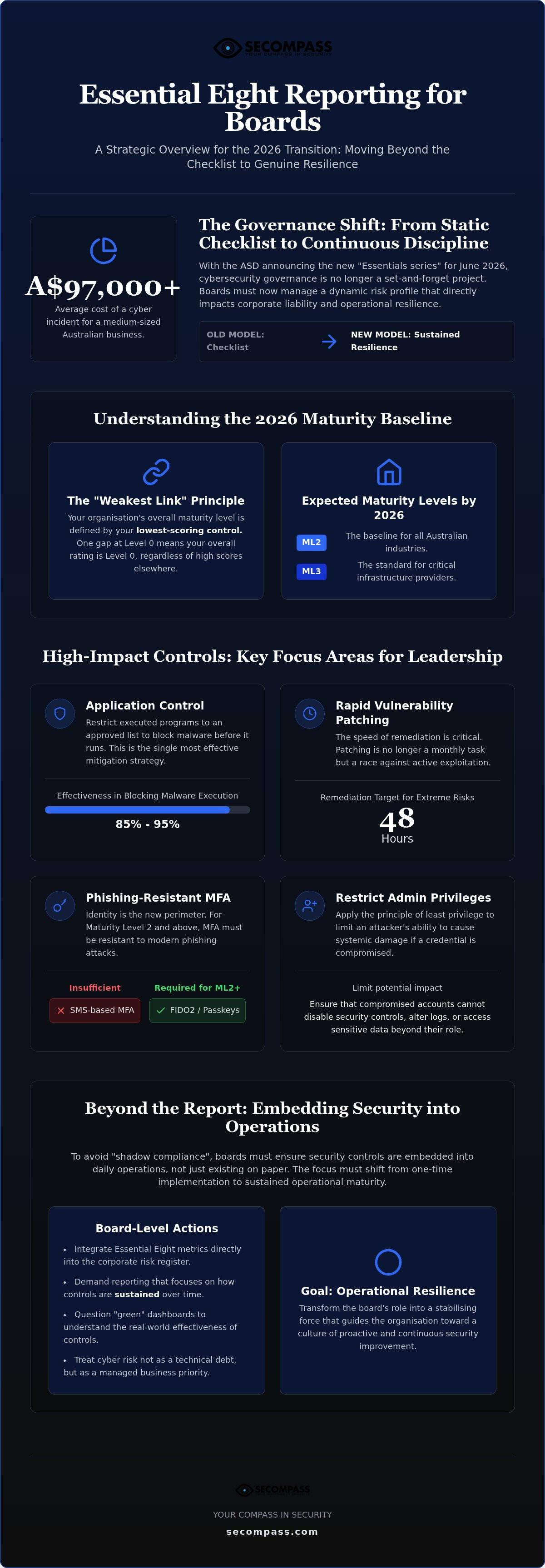
The Australian Signals Directorate (ASD) changed the landscape in June 2026 by announcing the retirement of the traditional Essential Eight in favour of a new, domain-specific "Essentials series." For directors, this transition period signifies that cybersecurity is no longer a set-and-forget project; it's a continuous governance discipline. Effective Essential Eight reporting for boards now requires a shift in perspective. You aren't just checking boxes. You're managing a dynamic risk profile that directly impacts your corporate liability and operational resilience. With the average cost of cybercrime for medium-sized Australian businesses now exceeding A$97,000 per incident, the financial stakes of governance failures are tangible.
As of January 2026, Maturity Level 2 (ML2) became the recommended baseline for all Australian industries. This shift reflects the increasing sophistication of threats. Insurers have followed suit. Most underwriters now mandate proof of Maturity Level 1 just to offer a policy, while achieving ML2 often results in more favourable premiums. For a foundational understanding of these standards, an Essential Eight framework overview provides the context for how these Australian requirements align with global security expectations.
Understanding the Maturity Model
The framework is structured into three maturity levels, but the most critical rule for any board to understand is the "weakest link" principle. Your organisation's overall maturity is defined by your lowest-scoring control. If you achieve Level 3 in seven areas but remain at Level 0 for Multi-Factor Authentication, your official rating is Level 0. This methodology ensures that technical gaps aren't hidden by high performance in easier-to-manage areas. By 2026 standards, critical infrastructure providers are expected to maintain Level 3, while most enterprises should be actively working toward the Level 2 baseline to ensure robust protection.
Governance and Leadership Accountability
Active oversight requires moving beyond passive acceptance of "green" dashboards. Boards should integrate Essential Eight metrics directly into the corporate risk register and annual reports. This transparency demonstrates to shareholders and regulators that leadership takes accountability for systemic integrity. When refining Essential Eight reporting for boards, focus on how controls are being sustained rather than just implemented. This level of inquiry transforms cyber risk from a hidden technical debt into a managed business priority, allowing the board to act as a stabilising force during the transition to the new Essentials series.
The 2026 Essential Eight Compliance Checklist: A Strategic Overview
Application control remains the most effective technical mitigation strategy in the ASD's arsenal. By restricting executed programmes to a pre-approved list, organisations can prevent 85% to 95% of malware execution before it begins. When reviewing Essential Eight reporting for boards, directors should look for evidence that these controls extend across all workstations and servers, rather than just a subset of the environment. This oversight ensures that "shadow IT" or unmanaged devices don't become an entry point for lateral movement within the network.
The speed of remediation is equally vital. Patching applications is no longer a monthly task; it's a race against exploitation. Current standards require the remediation of extreme risk vulnerabilities within 48 hours. To achieve this, leadership must support the automation of patch management systems. Additionally, hardening user applications by removing unnecessary features in web browsers and PDF software reduces the available attack surface. Restricting Microsoft Office macros to only those from trusted, internally managed locations further prevents the execution of malicious code often delivered via sophisticated phishing campaigns.
Restricting Administrative Privileges and MFA
Identity is the new perimeter. Multi-Factor Authentication (MFA) is now a non-negotiable requirement for all internet-facing services, including office productivity suites and remote access tools. For Maturity Level 2 and above, the framework mandates phishing-resistant MFA, such as FIDO2 hardware keys or passkeys. SMS-based authentication is no longer considered sufficient. Coupled with this is the principle of least privilege. Restricting administrative access ensures that even if a credential is compromised, the attacker's ability to make systemic changes or disable security logs is severely limited. To determine how these requirements align with your specific risk profile, you may wish to schedule a security assessment to evaluate your current maturity.
Patching Operating Systems and Daily Backups
Maintaining supported operating systems is a fundamental requirement of the Official Essential Eight Guidelines. Boards must be informed when legacy systems reach end-of-life, as these cannot be patched against new threats. Finally, a robust backup regime serves as the ultimate safety net. In 2026, the focus has shifted toward ensuring backups are disconnected from the network. This "air-gapping" ensures that even if ransomware encrypts your primary data, your recovery points remain untouched and ready for restoration. Clear Essential Eight reporting for boards should provide assurance that these backups are not only performed daily but are also regularly tested for integrity.
Bridging the Implementation Gap: The Path to Sustained Maturity
Shadow compliance remains a significant risk for Australian organisations. This occurs when controls appear robust on paper but are bypassed or poorly maintained in daily practice. For directors, relying on static, point-in-time reports can create a false sense of security. Genuine operational resilience requires moving beyond a tick-box mentality. A Virtual CISO acts as a strategic mentor, providing the continuous oversight needed to ensure technical settings align with the board’s risk appetite. This leadership role is vital for translating complex technical data into meaningful Essential Eight reporting for boards.
Independent validation is no longer optional. With the ASD’s new IRAP Quality Assurance Framework released in January 2026, there is greater scrutiny on the evidence provided by assessors. Boards should demand regular, independent assessments to verify maturity claims. This rigour ensures your organisation is prepared not only for the current Australian Government's Essential Eight but also for broader international benchmarks. For many firms, this maturity journey naturally leads to seeking ISO 27001 certification, which provides a globally recognised framework for information security management.
Continuous Monitoring vs. Annual Audits
A point-in-time audit is a snapshot of a single day. In a modern threat landscape, this approach is insufficient. Continuous monitoring allows for the early detection of configuration drift, where security settings slowly degrade over time. Building a culture of security awareness ensures that staff understand the why behind the controls, reducing the likelihood of internal workarounds that compromise your compliance status.
Your Cybersecurity Maturity Journey
Developing a phased implementation plan allows your organisation to balance security uplift with operational efficiency. This methodical progression ensures that maturity is sustained rather than rushed. SeComPass partners with firms across Melbourne and Auckland to navigate this complex roadmap. We provide the quiet expertise required to move from basic compliance to a position of strategic assurance, ensuring your leadership team remains confident and informed at every milestone.
Securing Your Organisation’s Future Through Strategic Oversight
The transition toward the new Essentials series and the standardisation of Maturity Level 2 as a baseline for Australian enterprises mark a significant evolution in governance. Effective Essential Eight reporting for boards is now the primary mechanism for demonstrating leadership accountability to insurers, regulators, and shareholders alike. By moving beyond technical checklists and embracing a model of continuous, independent validation, your organisation can transform cybersecurity from a source of friction into a driver of business enablement.
SeComPass provides specialised Virtual CISO leadership for firms in Melbourne and Auckland, bridging the gap between technical requirements and executive-level assurance. Our expertise in ACSC and international frameworks ensures your maturity journey is methodical, stable, and aligned with your long-term operational goals.
Building a resilient organisation is a journey of steady progress. With the right strategic guidance, your board can lead with confidence in an increasingly complex landscape.
Frequently Asked Questions
Is the Essential Eight mandatory for private businesses in Australia?
While the framework isn't a universal legal requirement for the private sector, it has become a commercial necessity. As of 2026, Maturity Level 2 is the formal baseline for over 90% of federal government procurement tenders. Additionally, most cyber insurance underwriters now mandate proof of at least Maturity Level 1 to issue or renew policies, making compliance a prerequisite for strategic risk management.
What is the difference between Essential Eight Maturity Level 2 and Level 3?
Maturity Level 2 is the current recommended baseline for all Australian industries, designed to defend against adversaries who use increasingly sophisticated tools. Maturity Level 3 is the expectation for critical infrastructure and the defence supply chain. It requires more advanced mitigations, such as stricter patching timelines and phishing-resistant authentication, to protect against highly targeted attacks from professional cybercrime groups.
How often should our organisation conduct an Essential Eight audit?
Annual audits are the historical standard, but the 2026 regulatory environment favours more frequent validation. Many boards now request quarterly maturity updates to prevent configuration drift. This shift is reinforced by the January 2026 IRAP Quality Assurance Framework, which places greater scrutiny on the methodology and evidence provided by assessors, making continuous monitoring more effective than a single point-in-time check.
Can we achieve Essential Eight compliance without a full-time CISO?
Yes, many organisations manage their security maturity through a Virtual CISO (vCISO) model. This approach provides the high-level strategic oversight required for Essential Eight reporting for boards without the cost of a full-time executive. A vCISO ensures that technical controls are correctly implemented while translating complex security metrics into clear business risk terms that directors can use to make informed decisions.

Article by
Jatinder Oberoi
Founder and Principal Consultant at SeComPass, a cybersecurity, privacy, governance, and compliance advisory firm supporting organisations across Australia and New Zealand. With extensive experience in cybersecurity leadership, risk management, ISO 27001, SOC 2, privacy, and governance advisory, he works closely with executive teams to help organisations strengthen operational resilience and improve cybersecurity maturity.
Known for his pragmatic and business focused approach, Jatinder specializes in translating complex cybersecurity and compliance challenges into clear, actionable strategies for leadership teams. His work focuses on helping organisations align security initiatives with business objectives, governance expectations, regulatory obligations, and long term resilience outcomes.
Through SeComPass, he regularly advises organisations on cybersecurity governance, AI risk, third party risk, compliance frameworks, security leadership, and enterprise resilience. His writing and advisory approach emphasizes clarity, practical decision making, and sustainable security maturity over fear driven cybersecurity messaging.


