
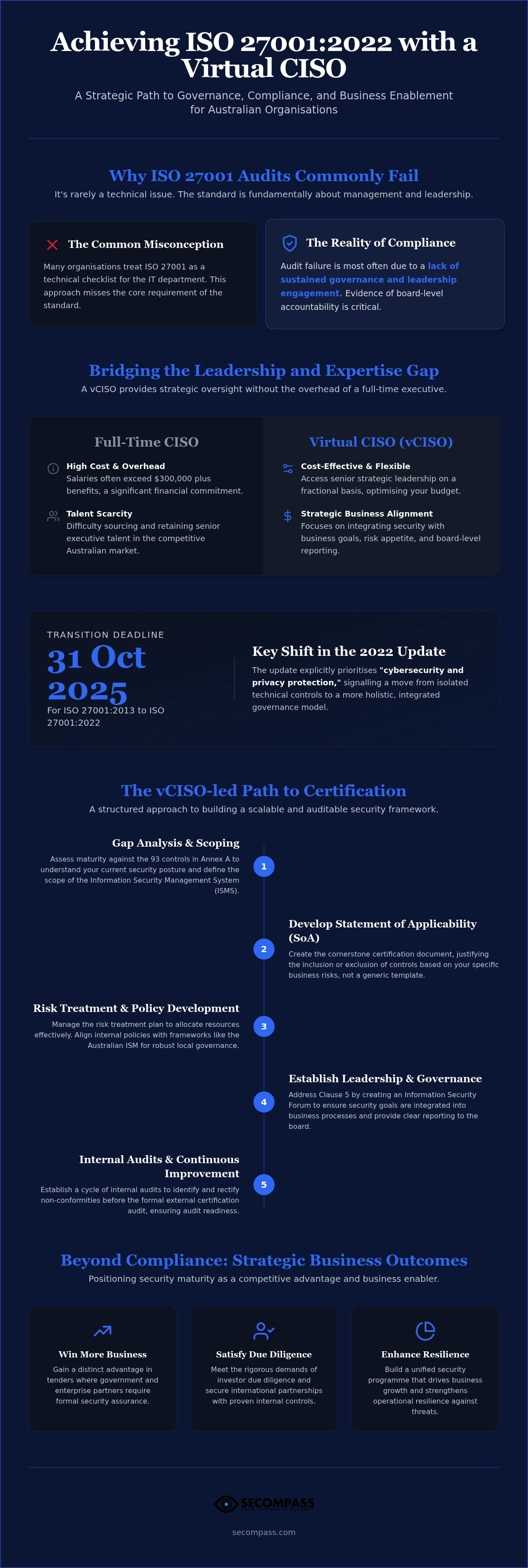
Many Australian organisations mistakenly view ISO 27001 as a technical hurdle to be cleared, yet the most common reason for audit failure is a lack of sustained governance and leadership. With the October 2025 transition deadline for ISO 27001:2022 approaching, the pressure to demonstrate security maturity has reached a critical point, especially when international partners demand rigorous proof of your internal controls. Engaging a vCISO for ISO 27001 allows your business to bypass the scarcity and high cost of the local executive talent market, where full-time salaries often exceed $300,000 plus benefits.
You likely recognise that achieving this certification is a significant undertaking that requires more than just a technical checklist. It demands a cultural shift and clear accountability at the board level. This article explores how a Virtual CISO provides the strategic leadership and governance required to achieve and maintain ISO 27001 certification without the overhead of a full-time executive. We will examine the path to building a scalable security framework that satisfies auditors while delivering clear, analytical reporting for your stakeholders and enterprise partners.
Key Takeaways
- Understand why ISO 27001 is fundamentally a management standard requiring active leadership engagement and strategic oversight.
- See how engaging a vCISO for ISO 27001 bridges the gap between technical implementation and board-level risk appetite.
- Learn to develop a Statement of Applicability that reflects your specific business risks rather than adopting generic compliance templates.
- Establish a cycle of continuous improvement through internal audit programmes that identify non-conformities before external certification audits.
- Position your security maturity as a business enabler to satisfy investor due diligence and secure international partnerships.
Navigating the ISO 27001 Governance Landscape in Australia
The ISO/IEC 27001 standard is frequently mischaracterised as a technical hurdle for the IT department to clear. In reality, the 2022 update to the standard explicitly prioritises "cybersecurity and privacy protection," signalling a shift towards holistic governance rather than isolated technical controls. For Australian organisations, this means that certification is no longer a "set and forget" exercise. It requires a continuous cycle of leadership engagement and risk-based decision-making. In the context of ISO 27001, a vCISO is a strategic mentor who oversees the architecture and governance of an organisation's information security management system to ensure it aligns with executive objectives.
To better understand this concept, watch this helpful video:
Engaging a vCISO for ISO 27001 provides a bridge between high-level board expectations and the granular realities of technical implementation. This is particularly relevant given the October 31, 2025, deadline for transitioning from the 2013 version. Australian businesses must now navigate a landscape where the Privacy Act reforms and sector-specific regulations from bodies like APRA demand higher levels of accountability. A virtual lead ensures that security is not just a defensive posture but a core component of the business strategy.
The Leadership Gap in Modern Security Frameworks
Technical teams often struggle with Clause 5 (Leadership) requirements because these mandates involve setting strategic objectives that sit outside the remit of IT operations. A vCISO fills this gap by establishing an Information Security Forum. This group ensures that security goals are integrated into business processes and that the board has a clear, analytical view of the risk landscape. Without this executive-level guidance, organisations often fail audits not because their firewalls are weak, but because their governance documentation lacks evidence of senior management participation.
Aligning ISO 27001 with Australian Business Goals
Achieving certification offers a distinct competitive advantage during the local tender process, where government and enterprise partners now require formal assurance of security maturity. This alignment often requires integrating local frameworks, such as the Essential Eight Implementation, into the broader international standard. A vCISO ensures these localised requirements are mapped accurately against ISO controls. This approach creates a unified security programme that satisfies both domestic expectations and global standards, turning compliance into a driver for business growth and operational resilience.
Implementing the ISMS Through Strategic vCISO Leadership
The implementation of an Information Security Management System (ISMS) begins with a clear understanding of your current security posture. A vCISO leads the initial gap analysis to determine the organisation's maturity against the 93 controls found in Annex A of the 2022 standard. Rather than applying a generic template, the advisor develops a Statement of Applicability (SoA) that reflects actual business risks and operational realities. This document is the cornerstone of your certification. It justifies why certain controls are included or excluded based on your specific threat landscape. To ensure compliance remains practical, the vCISO manages the risk treatment plan to ensure resources are allocated effectively toward the most significant vulnerabilities.
This process often involves aligning internal policies with the Australian Information Security Manual to provide a robust foundation for local governance. By establishing a culture of security through executive-led awareness programmes, the vCISO ensures that security becomes a shared responsibility rather than a siloed IT function. This top-down approach is essential for meeting the leadership requirements that auditors scrutinise during the certification process.
From Gap Analysis to Audit Readiness
A pragmatic gap analysis prevents the common pitfall of over-engineering security controls, which can lead to operational friction and unnecessary expenditure. Understanding the cost of ISO 27001 certification is essential for setting realistic budget expectations early in the project. The vCISO prepares the organisation for the two-stage certification process. Stage 1 focuses on documentation and readiness, while Stage 2 involves a deep-dive audit of control effectiveness. Having an expert guide ensures that your team feels confident and prepared when the external auditor arrives.
Managing Third-Party and Supply Chain Risks
In a SaaS-heavy environment, your security is only as strong as your weakest vendor. Using ISO 27001 as a framework, the vCISO strengthens vendor management processes by conducting rigorous reviews of third-party contracts and their security postures. This proactive oversight reduces the likelihood of supply chain disruptions and ensures that your data remains protected even when managed by external partners. Engaging a vCISO for ISO 27001 provides the assurance that your supply chain risks are managed with the same rigour as your internal systems. If you are ready to move beyond technical checklists, you can schedule a security assessment to begin your certification journey.
Ensuring Continuous Compliance and Board-Level Assurance
Achieving the initial certificate is a significant milestone, but the real test of an organisation's maturity begins the day the external auditor leaves. ISO 27001 is designed as a living framework that requires a cycle of continuous improvement rather than a static "set and forget" approach. This is where the partnership with a vCISO for ISO 27001 becomes most valuable, as it prevents the compliance decay that often follows a successful audit. For those seeking a foundational ISO 27001 overview, the standard's core value lies in its ability to adapt to changing organisational risks and operational requirements over time.
The vCISO manages the internal audit programme to identify non-conformities before they escalate into issues during the external surveillance audit. This proactive oversight ensures that leadership remains accountable and that the Information Security Management System (ISMS) remains aligned with the actual risk profile of the business. By reporting specific security metrics and maturity levels, the advisor provides the board with a clear, evidence-based view of the organisation's defensive posture. The vCISO uses the management review process to drive strategic security investment by identifying exactly where resource allocation will most effectively reduce residual risk and protect business value.
The Internal Audit and Management Review Cycle
The internal audit is the most critical tool for maintaining your certificate because it provides an objective health check of your control effectiveness. It's not about finding fault. It's about identifying opportunities for improvement before they become systemic failures. A vCISO facilitates the annual management review with senior leadership, ensuring that the ISMS remains suitable, adequate, and effective in the face of new threats or business changes. This process transforms audit findings into actionable business intelligence for the executive team.
Building Long-Term Security Maturity
True security maturity involves evolving beyond basic compliance toward genuine operational resilience. As your organisation grows and your risk landscape shifts, the vCISO engagement scales to meet these new challenges. This long-term partnership ensures that your security framework doesn't just sit on a shelf. It actively enables business growth by building deep trust with clients, investors, and regulators across the Australian and global markets. If you are ready to discuss your cybersecurity maturity journey, speak with our experts today.
Advancing Your Security Governance Strategy
Achieving ISO 27001 certification is a significant milestone that signals your organisation's commitment to protecting partner and client data. However, the true value of the standard is realised through sustained governance and the integration of security into your broader business objectives. By moving beyond a checklist mentality, you transform a technical requirement into a scalable framework for operational resilience and market growth.
Engaging a vCISO for ISO 27001 provides the senior leadership necessary to navigate complex regulatory landscapes while avoiding the significant overhead of a full-time executive hire. This partnership model ensures that your security programme remains agile, meeting both the 2022 standard requirements and the evolving expectations of your stakeholders. With expert advisory teams based in Melbourne and Auckland, SeComPass provides the stabilising leadership required to manage complex certifications and align security with long-term business enablement.
We look forward to helping you build a foundation of trust and strategic clarity for your organisation.
Frequently Asked Questions
What is the specific role of a vCISO during an ISO 27001 audit?
A vCISO for ISO 27001 acts as the primary liaison between your organisation and the external auditor, representing the leadership's commitment to the management system. They defend the strategic rationale behind risk treatment decisions and ensure that evidence of control effectiveness is presented clearly. By managing the audit process, they allow your internal teams to focus on operations while ensuring that any non-conformities are addressed with a professional and analytical approach.
How does a vCISO differ from an ISO 27001 consultant?
While a consultant typically focuses on a specific project or technical implementation, a vCISO for ISO 27001 serves as a long-term leadership partner. They provide ongoing governance, accountability, and board-level reporting rather than just delivering a one-off set of documents. This partnership model ensures that security maturity is integrated into the business strategy, providing a stabilising force that extends far beyond the initial certification project.
Can a vCISO help us transition to the ISO 27001:2022 version?
Yes, a vCISO manages the transition to the ISO 27001:2022 standard, which must be completed before the October 31, 2025, deadline. They assist in integrating the 11 new controls, including threat intelligence and data leakage prevention, into your current management system. This ensures your certification remains valid and reflects the current cybersecurity landscape while providing the board with assurance that transition risks are being professionally managed.
How many hours per month does a vCISO typically spend on ISO 27001 maintenance?
The time commitment for maintaining an ISMS typically ranges from 10 to 20 hours per month for a mid-sized Australian business. This period allows the vCISO to oversee internal audit schedules, manage risk treatment plans, and prepare reports for the quarterly management review. By engaging a fractional leader, you ensure that the ISMS remains a living system that evolves with your business goals without requiring a full-time executive presence.

Article by
Jatinder Oberoi
Founder and Principal Consultant at SeComPass, a cybersecurity, privacy, governance, and compliance advisory firm supporting organisations across Australia and New Zealand. With extensive experience in cybersecurity leadership, risk management, ISO 27001, SOC 2, privacy, and governance advisory, he works closely with executive teams to help organisations strengthen operational resilience and improve cybersecurity maturity.
Known for his pragmatic and business focused approach, Jatinder specializes in translating complex cybersecurity and compliance challenges into clear, actionable strategies for leadership teams. His work focuses on helping organisations align security initiatives with business objectives, governance expectations, regulatory obligations, and long term resilience outcomes.
Through SeComPass, he regularly advises organisations on cybersecurity governance, AI risk, third party risk, compliance frameworks, security leadership, and enterprise resilience. His writing and advisory approach emphasizes clarity, practical decision making, and sustainable security maturity over fear driven cybersecurity messaging.


