
Imagine sitting in a quarterly board meeting where the conversation has shifted from the firewall's uptime to how a recent supply chain incident affects your firm's operational resilience under APRA's CPS 230. For many Australian executives, these sessions highlight the urgent need for mature Security Leadership that can translate technical risk into clear business impact. You likely recognise the pressure to report on cyber threats with confidence, yet you are often met with overwhelming jargon or a shortage of senior talent capable of leading the conversation in the AU/NZ market.
Transitioning from a reactive technical posture to a strategic leadership model is essential for protecting your long-term growth and building board-level assurance. This article provides a framework to help you evolve your security function into a business-enabling powerhouse. We will examine the essential pillars of modern governance, the impact of upcoming 2026 regulatory shifts, and how to position your security maturity as a genuine lever for client trust and international expansion.
Key Takeaways
- Learn how to shift your focus from managing tools to mature Security Leadership that translates technical vulnerabilities into business-centric risk assessments.
- Understand how to align your organisational strategy with frameworks such as the NIST CSF 2.0 and the ASD Essential Eight to build a resilient governance structure.
- Discover how a Virtual CISO (vCISO) provides a scalable way to inject senior expertise into your team without the significant cost of a full-time executive hire.
- Gain practical insights into reporting cyber risk to the board in a way that fosters confidence and supports long-term business enablement.
- Explore how robust security governance facilitates international expansion and strengthens client trust through recognised certifications like ISO 27001 and SOC 2.
Security Leadership as a Strategic Business Enabler
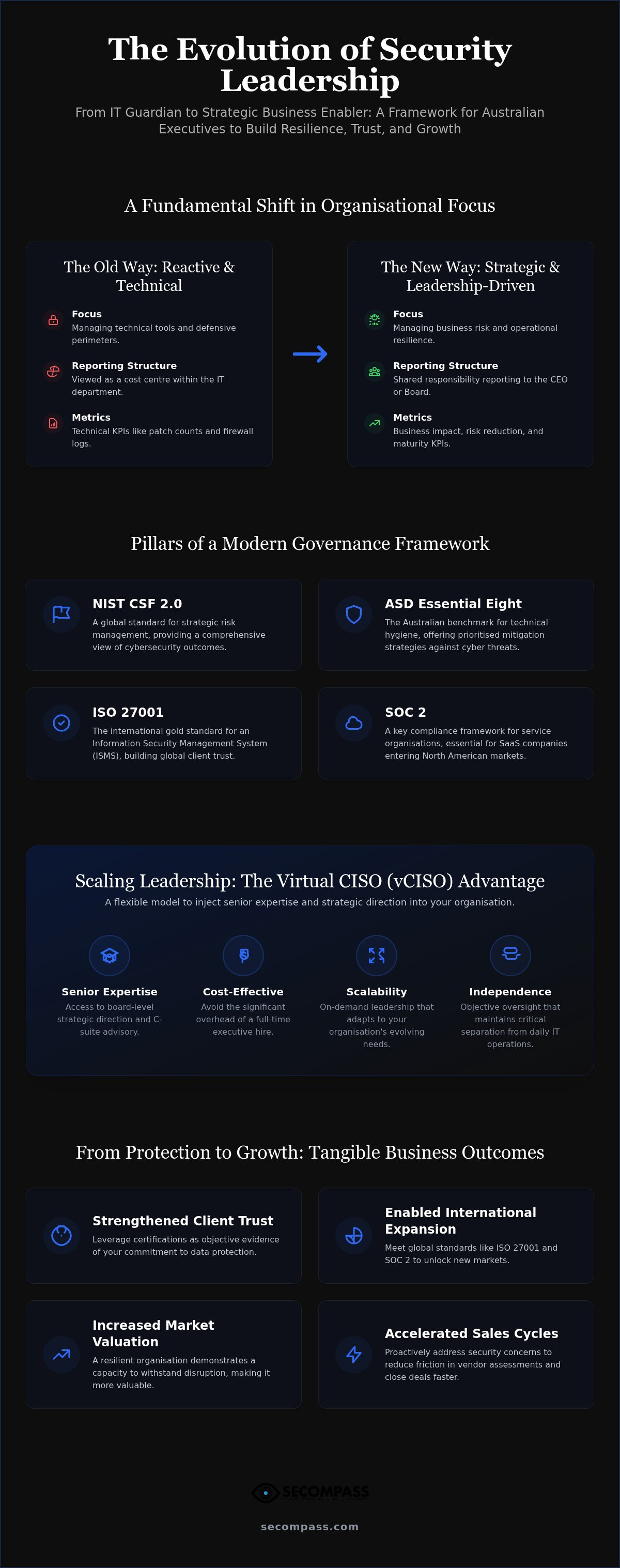
Effective Security Leadership represents a fundamental shift in how an organisation views protection. Historically, the focus remained on managing technical tools and defensive perimeters; today, the priority is managing technology risk and business resilience. This evolution requires a leader who can translate complex technical vulnerabilities into clear business impacts that resonate with the board. When leadership understands that a software flaw isn't just a bug but a potential disruption to cash flow or customer trust, they can make informed decisions about resource allocation.
Security leadership is the strategic oversight of an organisation’s information integrity and operational continuity. It's a role that prioritises enablement over restriction. By integrating security into the early stages of product development or service delivery, leaders ensure that processes support the sales cycle. This proactive stance reduces the friction often found during vendor security assessments, allowing the business to close deals faster and with greater confidence.
Moving Beyond the IT Department
For security to be truly effective, it must maintain independence from daily IT operations. This is why modern Security Leadership often reports directly to the CEO or the Board. When the Chief Information Security Officer (CISO) has a seat at the executive table, security is no longer viewed as a cost centre within the IT budget but as a shared responsibility across all business units. This structural shift fosters a culture of accountability where every department head understands their role in maintaining the organisation's defensive posture. For many firms, engaging a Virtual CISO provides this high-level strategic direction without the overhead of a permanent executive hire.
The Governance of Trust
In the Australian and New Zealand markets, trust is a primary currency for growth. Leadership leverages recognised certifications like ISO 27001 to provide objective evidence of their commitment to data protection. These frameworks do more than satisfy compliance; they build external trust with partners and clients who are increasingly wary of third-party risks. Linking security maturity to brand reputation directly influences long-term market valuation. A resilient organisation is a more valuable one, as it demonstrates a capacity to withstand and recover from the disruptions of a digital economy.
Building a Governance Framework for Operational Resilience
A robust governance framework acts as the blueprint for sustained Security Leadership. It ensures that protection efforts aren't merely reactive but are deeply embedded into the organisational fabric. In the Australian context, this involves aligning with global standards like the NIST CSF 2.0 while meeting local expectations through the Essential Eight Implementation. This dual approach provides a comprehensive view of both strategic management and technical hygiene, creating a stable environment for growth.
Prioritising a risk-based approach is vital. Rather than attempting to secure every asset with equal intensity, leaders must identify and protect the most critical business functions. This strategy extends to privacy obligations under the Australian Privacy Act and the NZ Privacy Act 2020. Integrating privacy leadership ensures that data handling practices meet stringent regulatory demands, thereby reducing the risk of costly breaches and regulatory scrutiny. If you are beginning this process, you may wish to discuss your cybersecurity maturity journey with a specialist advisor.
Framework Selection and Implementation
Choosing the right framework depends on your target market and specific client requirements. ISO 27001 remains a global gold standard for information security management systems, whereas SOC 2 is often a prerequisite for SaaS companies looking to enter the North American market. For many local firms, The Executive Guide to SOC 2 Readiness Assessments for Australian SaaS offers a practical starting point for understanding these requirements. The right selection ensures that your security investments translate directly into market access and client assurance.
Reporting to the Board
Directors require clarity, not technical clutter. Effective Security Leadership involves developing KPIs that reflect maturity and risk reduction rather than simplistic metrics like patch counts or firewall logs. When presenting a Cybersecurity Strategy for Australian Mid-Market Firms, focus on how security controls mitigate specific business risks. Utilising a Virtual CISO (vCISO) model can help bridge this communication gap, providing an executive voice that speaks the language of the board while maintaining technical integrity.
The Virtual CISO Model: Scaling Leadership in 2026
With Australian cybersecurity spending projected to increase by 9.5% in 2026, the demand for senior guidance has reached a critical point. However, the salary for a full-time CISO, typically between $216,000 and $268,000, remains a significant investment for many organisations. The Virtual CISO (vCISO) model addresses this by providing fractional access to elite expertise. This approach allows firms to overcome the local skills shortage, which is expected to reach 54,000 professionals by 2030, while maintaining a lean operational structure.
A vCISO serves as a wise guide, orchestrating complex initiatives such as SOC 2 readiness assessments and comprehensive third-party risk management. This level of strategic security leadership ensures that your programme aligns with global standards. Referencing the NIST Information Security Guide for Government Executives, it's clear that executive-level oversight is the linchpin of operational continuity. SeComPass positions your business for growth by providing the mature leadership required to navigate these complexities.
Establishing a Path to Fractional Leadership
The transition to a fractional model begins with a thorough maturity assessment to identify existing leadership gaps. Once the baseline is established, we define the scope of the vCISO role, covering everything from policy development to incident response oversight. We then establish a consistent cadence for strategic reviews and board reporting. This structured approach ensures that security remains a board-level priority without requiring a full-time executive presence.
Sustaining Maturity and Enablement
Moving from reactive fire-fighting to a proactive posture requires stability. Outsourced leadership provides the consistent oversight needed to achieve and maintain international certifications. This maturity acts as a catalyst for business expansion, particularly when entering markets with high regulatory hurdles. SeComPass facilitates this journey through our specialised vCISO and vDPO services, ensuring your security function evolves into a genuine competitive advantage.
Advancing Your Organisational Resilience
Mastering Security Leadership is a process of continuous refinement rather than a single destination. By shifting from reactive technical management to strategic oversight, Australian executives can transform security from a cost centre into a powerful lever for growth. This transition ensures that your governance frameworks, such as the Essential Eight and ISO 27001, serve as foundations for operational resilience and international expansion.
SeComPass provides the senior guidance needed to navigate this landscape, offering a proven track record in certification readiness and deep expertise in local privacy regulations. Our strategic vCISO leadership injects mature, boardroom-ready perspective into your organisation, allowing you to build client trust while maintaining a lean operational structure.
Strengthening your defensive posture today ensures your organisation is prepared to capitalise on the strategic opportunities of the coming years.
Frequently Asked Questions
What is the difference between security management and security leadership?
Security management focuses on the technical execution of controls and the daily maintenance of protective tools. In contrast, Security Leadership involves the strategic alignment of risk management with broader business objectives. While a manager ensures a firewall is configured correctly, a leader ensures the organisation's risk appetite is defined and that security investments facilitate sustainable growth and board-level assurance.
Do Australian small businesses really need a dedicated security leader?
Small businesses increasingly require dedicated guidance because they are integral parts of larger enterprise supply chains. Larger partners often demand evidence of security maturity before signing contracts or renewing agreements. Having a defined leader ensures the business can meet these expectations and comply with the Australian Privacy Act without the complexity of managing these requirements through an overstretched IT team.
How does a vCISO help with ISO 27001 or SOC 2 certification?
A vCISO provides the governance framework and strategic roadmap necessary to achieve these certifications. They translate the complex requirements of ISO 27001 or SOC 2 into actionable business processes, managing the readiness assessment and policy development phases. This oversight ensures that the certification isn't just a tick-box exercise but a sustainable part of the company's operational resilience and client trust strategy.
Can security leadership be outsourced effectively in Australia and New Zealand?
Outsourcing through a Virtual CISO model is a highly effective way for AU/NZ firms to access senior expertise without the overhead of a full-time hire. This approach provides a stabilising force that understands local regulatory environments, such as the ASD Essential Eight maturity levels. It allows organisations to scale their Security Leadership at a pace that matches their growth while maintaining a professional, partnership-oriented advisory relationship.

Article by
Jatinder Oberoi
Founder and Principal Consultant at SeComPass, a cybersecurity, privacy, governance, and compliance advisory firm supporting organisations across Australia and New Zealand. With extensive experience in cybersecurity leadership, risk management, ISO 27001, SOC 2, privacy, and governance advisory, he works closely with executive teams to help organisations strengthen operational resilience and improve cybersecurity maturity.
Known for his pragmatic and business focused approach, Jatinder specializes in translating complex cybersecurity and compliance challenges into clear, actionable strategies for leadership teams. His work focuses on helping organisations align security initiatives with business objectives, governance expectations, regulatory obligations, and long term resilience outcomes.
Through SeComPass, he regularly advises organisations on cybersecurity governance, AI risk, third party risk, compliance frameworks, security leadership, and enterprise resilience. His writing and advisory approach emphasizes clarity, practical decision making, and sustainable security maturity over fear driven cybersecurity messaging.


